

What Does Healthy Dog Poop Look Like? A Guide for Owners

At a glance
- Healthy poop is chocolate brown, firm but slightly moist, and holds its shape
- Colour is the fastest indicator of a problem — red, black, grey, or yellow all warrant attention
- Consistency matters: both very hard and very soft stools signal something is off
- Coating, mucus, or visible worms are red flags worth acting on quickly
- Diet is the single biggest driver of stool quality in healthy dogs
So what does normal actually look like?
Healthy dog poop is chocolate brown, firm enough to hold its shape, and slightly moist on the surface. It should be easy to pick up cleanly — not crumbling, not smearing, not leaving a residue on the ground. Think of it like a well-formed log. That is the benchmark.
Vets use a stool scoring system to rate consistency on a scale of 1 to 7. Score 1 is rock-hard pellets. Score 7 is liquid with no form at all. The ideal sits at 2 to 3: firm, segmented, easy to pick up, with a slight give when pressed.
Frequency varies by dog. Most healthy adult dogs go once or twice a day. Puppies go more often. What matters is consistency in the pattern — not an exact number.
What does poop colour tell you?
Colour is your first and fastest diagnostic tool. Brown is normal. Everything else is a signal.
- Bright red streaks — fresh blood, usually from the lower digestive tract or anal area. Can be caused by straining, a small tear, or colitis. Worth a vet visit if it continues.
- Black or very dark brown — digested blood from higher up in the gut. This needs a vet the same day.
- Yellow or orange — can indicate liver or gallbladder issues, or food passing through too quickly.
- Grey or pale — points to problems with fat digestion, sometimes linked to pancreatic or liver function.
- Green — grass eating is the common cause. If it happens consistently without grass eating, it can signal a gut motility issue.
- White chalky — often seen in dogs fed a raw diet with too much bone. The stool becomes powdery and can cause constipation.
One unusual stool is rarely cause for alarm. A pattern of unusual stools — or anything black, bloody, or accompanied by vomiting — needs professional attention.
What does consistency or coating tell you?
Consistency reveals how well your dog is digesting food. Coating tells you about the gut lining.
Hard, dry stools that crumble suggest dehydration or too much fibre without enough moisture in the diet. Loose, soft stools that still hold a shape are often a minor dietary blip — stress, a food change, or eating something they shouldn't. Chronic loose stools that recur over days or weeks point to something more persistent: a food intolerance, an imbalanced gut microbiome, or an underlying health condition.
A thin coating of mucus on the outside of a stool is the gut lining doing its job. A thick, jelly-like coating — especially if it contains blood — indicates inflammation in the large intestine (colitis). If this happens more than once or twice, see a vet.
Visible contents like undigested food, worms, or foreign material also matter. Worms require treatment. Undigested food suggests the gut is moving too fast or digestive enzymes are struggling.
How does diet affect stool quality?
Diet is the most direct lever you have. What goes in determines what comes out — literally.
Dogs fed highly processed dry food often produce larger, softer, or more odorous stools because a significant portion of the ingredients is either poorly digested or bulked with fillers. Higher-quality ingredients with fewer fillers tend to produce smaller, firmer, less smelly stools. How much a dog actually absorbs from their food varies considerably by format and ingredient quality.
Fibre plays a central role. Soluble fibre — like chicory root — feeds the beneficial bacteria in the gut and helps regulate stool consistency from both directions: it can firm up loose stools and soften hard ones. Getting fibre balance right in your dog's diet is one of the most underrated parts of digestive health.
Marleybones includes chicory root as a prebiotic in every recipe, alongside other gut-supporting ingredients like chia seeds and linseeds. All recipes are vet-developed, so the fibre and nutrient balance is designed to support consistent stool quality rather than just hitting minimum nutritional targets.
If you are switching food and notice changes in stool consistency, that is normal in the short term. Transition over 7 to 10 days and stools should settle. Moving to a new diet gradually significantly reduces the chance of digestive upset during the changeover.
If your dog has persistent soft stools that don't settle with a food change, a targeted gut health supplement with pre- and probiotics can help rebalance the digestive system.
Every dog is different — build your personalised Marleybones feeding and health plan tailored to your dog's age, size, and health requirements.

“Such a relief to see her enjoying her food”
FAQs
How many times a day should a dog poop?
Most adult dogs poop once or twice a day. Puppies poop more frequently, sometimes after every meal. What matters is regularity — a consistent pattern for your dog is more meaningful than a fixed number.
Is it normal for dog poop to have a bit of mucus on it?
A small amount of mucus coating is normal — it is produced by the gut lining to help stools pass. A heavy, jelly-like coating or mucus mixed with blood is not normal and warrants a vet visit, especially if it persists beyond a day or two.
My dog's poop changed when I switched their food. Is that normal?
Yes, a change in stool consistency during a food transition is expected. The gut microbiome takes time to adjust to new ingredients. Transitioning gradually over 7 to 10 days — increasing the new food slowly while reducing the old — gives the digestive system time to adapt without significant upset.
Why is my dog's poop very small and hard?
Hard, small stools usually indicate dehydration or too much insoluble fibre without enough moisture in the diet. Make sure your dog has constant access to fresh water, and consider whether their food contains adequate moisture. Dogs on dry-only diets are more prone to this.
When should I take a dog with abnormal poop to the vet?
If loose stools last more than 48 hours, if there is blood in the stool (especially dark or black blood), or if abnormal poop comes alongside vomiting, lethargy, or loss of appetite, see a vet promptly. A single unusual stool is rarely an emergency — a pattern of them is.
“A complete game changer!!”


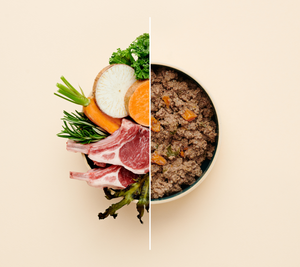 Give your dog the quality nutrition they deserve
Real meat, wholesome veggies and functional superfoods.
Get 40% OFF today