

Small-Breed Dog Food: How Portion and Nutrient Needs Differ

At a glance
- Small-breed dogs (under 10kg) have a faster metabolism and need more calories per kilogram of body weight than large-breed dogs.
- A small dog's stomach is proportionally tiny, so meals need to be nutrient-dense rather than just smaller in volume.
- Small breeds are prone to low blood sugar (hypoglycaemia) if meals are spaced too far apart, especially as puppies.
- Kibble or food piece size matters for small mouths and jaws, not just the total amount fed.
- Small breeds live longer on average and need feeding plans that adjust across a longer life stage timeline.
Why do small dogs need different food to large dogs?
Small dogs need proportionally more energy and nutrients per kilogram of body weight than large dogs, because their metabolic rate is higher relative to their size. A 4kg Chihuahua burns more calories per kilogram than a 40kg Labrador, purely because smaller bodies lose heat faster and have a higher ratio of surface area to volume. This means a straightforward scaled-down portion from a large-breed feeding guide will usually underfeed a small dog.
Small-breed dogs also have small stomachs relative to their size, so they cannot physically eat large volumes in one sitting. That makes nutrient density non-negotiable: every mouthful has to work harder. A general feeding and life stages guide is a good place to understand how these needs shift from puppyhood through to the senior years, since small breeds move through those stages faster than larger dogs.
How much should I feed a small-breed dog?
Most small-breed adult dogs need around 40 to 50 kcal per kilogram of body weight per day, compared with 25 to 35 kcal per kilogram for large-breed adults. Exact needs vary with activity level, neuter status, and individual metabolism, so this is a starting point rather than a fixed rule. A 5kg dog might need roughly 200 to 250 kcal a day, split across two or three meals rather than one.
Toy and small breeds are more prone to hypoglycaemia, particularly as puppies, because their small livers cannot store enough glycogen to keep blood sugar stable over long gaps between meals. Puppies under 4kg often need three to four small meals a day until they're at least four to six months old. Anyone working out exact quantities for a growing puppy will find it easier using a proper breakdown of age-appropriate puppy portions rather than guessing from adult guidelines.
| Body weight | Approx. daily calories (adult, moderate activity) | Suggested meals per day |
|---|---|---|
| 2kg | 140-180 kcal | 2-3 |
| 5kg | 250-320 kcal | 2 |
| 10kg | 400-500 kcal | 2 |
| 15kg (small-medium) | 550-650 kcal | 2 |
What nutrients matter most for small breeds?
Small breeds need higher concentrations of protein and fat per gram of food than large breeds, because they eat less food overall but still need the same range of nutrients. FEDIAF, the European body that sets nutritional standards for pet food, recommends a minimum of 21.3g of protein per 1,000 kcal for adult dogs, but small-breed diets tend to sit higher than this baseline to compensate for smaller meal volumes.
Small dogs are also more prone to dental disease, with studies suggesting toy and small breeds develop periodontal problems earlier and more severely than large breeds, partly due to overcrowded teeth. Kibble size and food texture matter here: pieces that are too large or too hard can be difficult for small jaws to manage comfortably. Fibre also plays a role in maintaining stable digestion in smaller guts, and chicory root is one of the most well-researched natural prebiotic fibres used in dog food, because it feeds the beneficial bacteria that support gut health. Marleybones includes chicory root among its superfood ingredients across its Pantry Fresh recipes, alongside quinoa and linseeds, aimed at supporting digestion without relying on synthetic additives.
Obesity risk is another factor that hits small breeds hard. A extra 100g on a 4kg dog is proportionally far more significant than the same 100g on a 30kg dog, so portion accuracy matters more, not less, for smaller animals. Overfeeding by even a small handful of extra kibble a day adds up quickly relative to their size. Speak to a vet if a small-breed dog is gaining weight steadily despite portions matching feeding guidelines, since underlying conditions like hypothyroidism can affect metabolism.
Do small breeds need a different feeding schedule as they age?
Small breeds need feeding adjustments earlier and more frequently than large breeds because they move through life stages faster and live longer overall. Many toy and small breeds are considered seniors from around 10 to 12 years old, whereas giant breeds can be classed as senior from as young as 5 or 6. That longer lifespan means more years spent in the adult and senior stages, so getting portion sizes right over the long term matters more cumulatively.
Senior small breeds often need slightly fewer calories as activity naturally declines, but the food still needs to be nutrient-dense to avoid muscle loss. A dedicated guide on how much to feed a senior dog covers how these adjustments should be made gradually rather than as a sudden cut in portion size.
Every dog is different, and breed, activity level, and health history all affect exact requirements. Every dog is different, build your personalised Marleybones feeding and health plan tailored to your dog's age, size, and health requirements. Small-breed owners looking for nutrient-dense, complete meals can compare recipes like Lush Lamb, formulated to FEDIAF standards and suitable for all life stages including puppies.

“Such a relief to see her enjoying her food”
FAQs
Do small dogs need smaller kibble pieces?
Yes. Small breeds have smaller mouths and jaws, so oversized or overly hard kibble pieces are harder to chew comfortably and can be swallowed whole, increasing choking risk. Most small-breed specific dry foods use noticeably smaller pieces than standard adult formulas.
How many times a day should a small dog eat?
Adult small breeds do well on two meals a day, while small-breed puppies under six months often need three to four meals to avoid blood sugar dips. Splitting daily calories across more, smaller meals suits their limited stomach capacity better than one large feed.
Why do small dogs eat more relative to their size?
Small dogs have a higher metabolic rate per kilogram of body weight than large dogs, driven largely by a greater surface-area-to-volume ratio that causes faster heat loss. This means they burn more energy proportionally and need more calories per kilogram to maintain body weight.
Can I feed a small breed the same food as a large breed?
Complete and balanced adult dog food meeting FEDIAF standards is nutritionally suitable for dogs of any size, but portion size and piece size need adjusting for small breeds. The food itself doesn't need to differ nutritionally, just the amount and format it's served in.
What happens if a small dog is underfed?
Underfeeding a small breed increases the risk of hypoglycaemia, particularly in puppies and toy breeds, causing lethargy, weakness, or shaking. Persistent underfeeding also leads to muscle loss and poor coat condition, so consult a vet promptly if a small dog shows sudden weakness or reluctance to eat.
“A complete game changer!!”


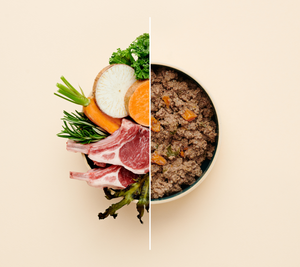 Give your dog the quality nutrition they deserve
Real meat, wholesome veggies and functional superfoods.
Get 40% OFF today