

How to calculate how much to feed your dog

At a glance
- Daily feeding amounts are based on a dog's target bodyweight — not their current weight if they're over or underweight
- A common starting formula is 2–3% of bodyweight per day for adult dogs on fresh food
- Puppies need more calories per kilogram of bodyweight than adult dogs — often 4–6% depending on age and breed size
- Activity level, neutering status, and food type all affect how much your dog actually needs
- Body condition scoring — checking fat cover over the ribs — is the most accurate ongoing calibration tool
How do you actually calculate how much to feed your dog?
To calculate how much to feed your dog, multiply their target bodyweight in kilograms by the recommended daily percentage for their life stage and food type. For most adult dogs on fresh food, that's 2–3% of bodyweight per day. A 10kg adult dog would need roughly 200–300g of fresh food daily, split across two meals.
That percentage shifts depending on what you're feeding. Kibble is calorie-dense and low in moisture, so portions look much smaller. Fresh food contains 70–80% moisture, so portions look larger but deliver similar energy. Always check the calorie content (kcal per 100g) on the packaging and compare it against your dog's estimated daily energy requirement.
As a rough daily energy guide, a moderately active adult dog needs approximately 95 x (bodyweight in kg)^0.75 kcal per day. That formula — called the resting energy requirement, or RER — is the baseline used by vets and pet nutritionists. You then multiply it by an activity factor: around 1.4–1.6 for a moderately active adult, higher for working dogs, lower for neutered or less active ones. Most dogs fall in the 1.4–1.6 range, which means a 10kg moderate dog needs roughly 400–500 kcal per day.
The complete guide to dog food ingredients and nutrition labels explains how to find and interpret calorie information on packaging — useful if you're switching foods or comparing options.
Does the type of food change how you calculate portions?
Yes, significantly. The calorie density of a food determines how much volume your dog needs to eat to hit their daily energy target. Here's how common formats compare:
| Food type | Typical moisture content | Typical kcal per 100g | Daily amount for 10kg adult (approx.) |
|---|---|---|---|
| Dry kibble | 8–12% | 320–400 kcal | 110–140g |
| Wet/canned food | 75–85% | 70–100 kcal | 440–620g |
| Fresh food (lightly cooked) | 65–80% | 100–140 kcal | 300–450g |
| Raw food | 60–75% | 120–160 kcal | 280–380g |
These are approximate figures. Always use the specific kcal value on your chosen food, not category averages. Marleybones Pantry Fresh meals include a feeding guide calibrated to the actual calorie content of each recipe, which takes the guesswork out of that step.
Food quality also affects how efficiently calories are used. Higher-quality protein and fewer fillers mean more of the food is absorbed and used. That's one reason understanding what's actually in your dog's food matters when you're working out portions — two foods with identical calorie counts can deliver very different nutritional outcomes.
How do you adjust portions for puppies, seniors, and active dogs?
Puppies, senior dogs, and highly active dogs all need portion adjustments beyond the standard adult formula.
Puppies are growing rapidly. They need more calories per kilogram of bodyweight than adult dogs, and their requirements change week by week. A rough guide is 4–6% of expected adult bodyweight per day for young puppies, reducing gradually toward the adult rate as they approach 80% of their adult size. Large and giant breeds need careful portion control during growth — overfeeding a large-breed puppy can stress developing joints.
Senior dogs typically need 10–20% fewer calories than adults, particularly once activity levels drop. However, they still need high-quality protein to maintain muscle mass. Cutting protein to cut calories is a mistake — reduce overall quantity while keeping protein quality high.
Highly active dogs, working dogs, or those in intense training can need up to twice the calorie intake of a similar-sized sedentary dog. If your dog is burning energy consistently across the day, their daily kcal requirement can rise to a multiplier of 2.0–5.0 on top of their RER.
Neutered dogs have lower energy requirements than entire dogs of the same size, typically by around 20–30%. If your dog was neutered recently and you haven't adjusted portions yet, that's usually the first place to look if they're gaining weight.
How do you know if you're feeding the right amount?
Body condition scoring (BCS) is the most practical way to assess whether your dog is getting the right amount. It's a 9-point scale used by vets. A score of 4–5 is ideal. At the right weight, you should be able to feel your dog's ribs easily but not see them. There should be a visible waist when viewed from above, and a slight tuck behind the ribcage when viewed from the side.
Weigh your dog every 2–4 weeks and adjust portions in 5–10% increments. Small, gradual adjustments are more effective than large sudden changes. If your dog is consistently gaining or losing weight despite following pack guidelines, adjust by 10% and reassess after two weeks.
Every dog is different — build your personalised Marleybones feeding and health plan tailored to your dog's age, size, and health requirements.
If your dog is losing weight despite adequate portions, or gaining weight despite calorie restriction, consult your vet. Unexplained weight changes can signal underlying health conditions including thyroid issues, digestive disorders, or parasites.
Treats count toward daily calories. Most owners forget this. If your dog gets treats regularly, they should account for no more than 10% of total daily calorie intake, with the rest of their meals reduced accordingly. Marleybones meals are nutritionally complete, so it's straightforward to scale portions up or down while knowing the recipe stays balanced.

“Such a relief to see her enjoying her food”
Frequently asked questions
What percentage of bodyweight should I feed my dog?
For adult dogs on fresh food, 2–3% of bodyweight per day is the standard starting point. Puppies need 4–6% of expected adult bodyweight. Senior and less active dogs typically need toward the lower end of the adult range, around 1.5–2%. These percentages apply to fresh and raw food. For kibble, follow the kcal-based calculation instead, as the volume will be much lower.
Should I feed based on current weight or ideal weight?
Use your dog's ideal target weight, not their current weight. If your dog is overweight, feeding based on their actual weight will perpetuate the problem. Estimate their ideal weight by assessing their body condition score, or ask your vet to confirm a target weight. For underweight dogs, the same applies in reverse — feed to the target, not the current number.
How often should I feed my dog?
Most adult dogs do well on two meals per day, roughly 12 hours apart. Puppies under six months need three to four smaller meals daily to maintain stable blood sugar and support growth. Large and giant breeds benefit from two meals rather than one to reduce the risk of bloat. The total daily amount stays the same — you're dividing it, not increasing it.
How do I account for treats in my dog's daily intake?
Treats should make up no more than 10% of your dog's total daily calorie intake. Count the calories in treats before feeding, then reduce the main meal accordingly. If you're using treats heavily during training, use small, low-calorie treats and reduce meal portions on high-treat days. Ignoring treat calories is one of the most common reasons dogs gradually gain weight.
Do I need to change portions when I switch dog food brands?
Yes. Different foods have different calorie densities. If you move from a high-calorie kibble to a lower-calorie fresh food, feeding the same weight of food will under-nourish your dog. Always check the kcal per 100g on the new food and recalculate based on your dog's daily energy requirement. Reassess body condition after two to four weeks on the new food to confirm the amount is right.
“A complete game changer!!”


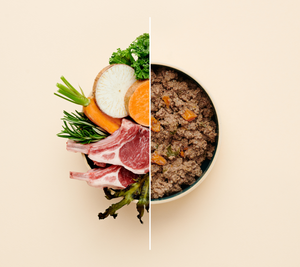 Give your dog the quality nutrition they deserve
Real meat, wholesome veggies and functional superfoods.
Get 40% OFF today